Article: We Are All Made From Stars: Interview with Benedikt Lehnert and Marc Majewski
We Are All Made From Stars: Interview with Benedikt Lehnert and Marc Majewski
From atoms to stars, 'We Are All Made From Stars' is a gentle story about how life transforms and continues. Both scientific and spiritual in tone, it gently shows that endings are also beginnings, and that we are, quite literally, made from the same stardust that fills the universe. We spoke to the book's writer Benedikt Lehnert and illustrator Marc Majewski.

Ben, what originally sparked the realisation that atomic science and stardust could be reframed as a comforting narrative for young kids?
Honestly, it wasn't a clever concept I went looking for. The idea for this book found me out of necessity. In early 2018 my mom was diagnosed with late-stage stomach cancer and died five months later. My daughter Emma wasn't even three, and within a single month she'd lost her grandmother and our family dog.
I suddenly had to explain death to a not-quite-three-year-old, and I realized I had no language for it myself. I grew up in a small, very Catholic town in post-war Germany, where death was met either with a grim "life goes on" or an afterlife story. Neither felt right or good enough to me.
While I was flying back and forth to Germany that summer, a mentor pointed me to Stephen Levine's book Who Dies?, and what stayed with me was the place where science and ancient wisdom meet.
The first law of thermodynamics says energy can't be created or destroyed. Every atom in us once belonged to something — or someone — else. And where does the energy go when things fall apart? We really are made of the same stuff as stars, and when we die, that matter and energy doesn't vanish; it goes on to make new things. That isn't a comforting metaphor I invented for children. It's simply true. And I found the truest thing was also the most consoling. That's the whole book.
Children's books require extreme restraint, and this is your first children’s book. What was your editing process like when trying to compress the concept of the universe into just a few punchy, rhythmic sentences?
I think what helped was that this, my first children’s book, was 8 years in the making. So, I had lots of time to figure things out. I wrote the first draft in late 2018 as a poem to my daughter. Then, as I was unsuccessfully looking to find great children’s books for Emma (she was born a voracious reader) that explained how life and death worked, the idea grew in me to turn the poem into a picture book.
Being originally trained as a graphic designer, in 2019 I made a first printed prototype which Emma helped me tape together. I would read the “book” to her and refine sentences, rhythm and certain words. Starting with a poem helped here because I was already trying to only leave the words that were absolutely necessary.
Then, for several years I left the draft and the dummy alone, sitting in both my physical and digital desk drawer. In 2023 I picked up the dummy again. Emma saw it on my desk, and now being 8 she was able to read it herself. Her sharp eyes noticed that I had omitted one of our senses in the line that talks about the things we can see, hear, smell and touch. So, she made sure I added “taste” to the manuscript.
Lastly, and this was the final part of the editing process, our amazing editor Friederike went through the manuscript word for word (in both English and German), and we tweaked a few lines right up to the last few weeks before going into print.

Coming from your background of design, tech, and business - very “adult” worlds - what was the most surprising or unexpected hurdle you encountered when your target audience suddenly shifted to young children?
This is a great question. I’ve loved children’s books ever since, well, being a child. Every book store I go to, the picture book section is the first one I go to; and over the years my personal collection has grown quite a bit.
What I love about picture books and writing for children is that there’s nowhere to hide. Children are my favorite people. They’re so curious, honest, down to earth, and full of life. They’re not impressed by big words and fancy phrases. And they’re so connected to their emotions.
Writing about such a big, emotional topic challenged me to see life, loss and grief through the eyes of my daughter. And the most surprising thing was how much that process of writing transformed my own grief into an immense feeling of gratitude, awe and wonder for life.
We should all listen a lot more to children when it comes to the big questions around how to be human. And use simple words and colorful pictures to express it all.
Marc, you are well-known for creating incredibly immersive visuals. When you first read Ben’s story about things completely invisible to the human eye - like atoms - how did you begin mapping out the visual vocabulary in the book?
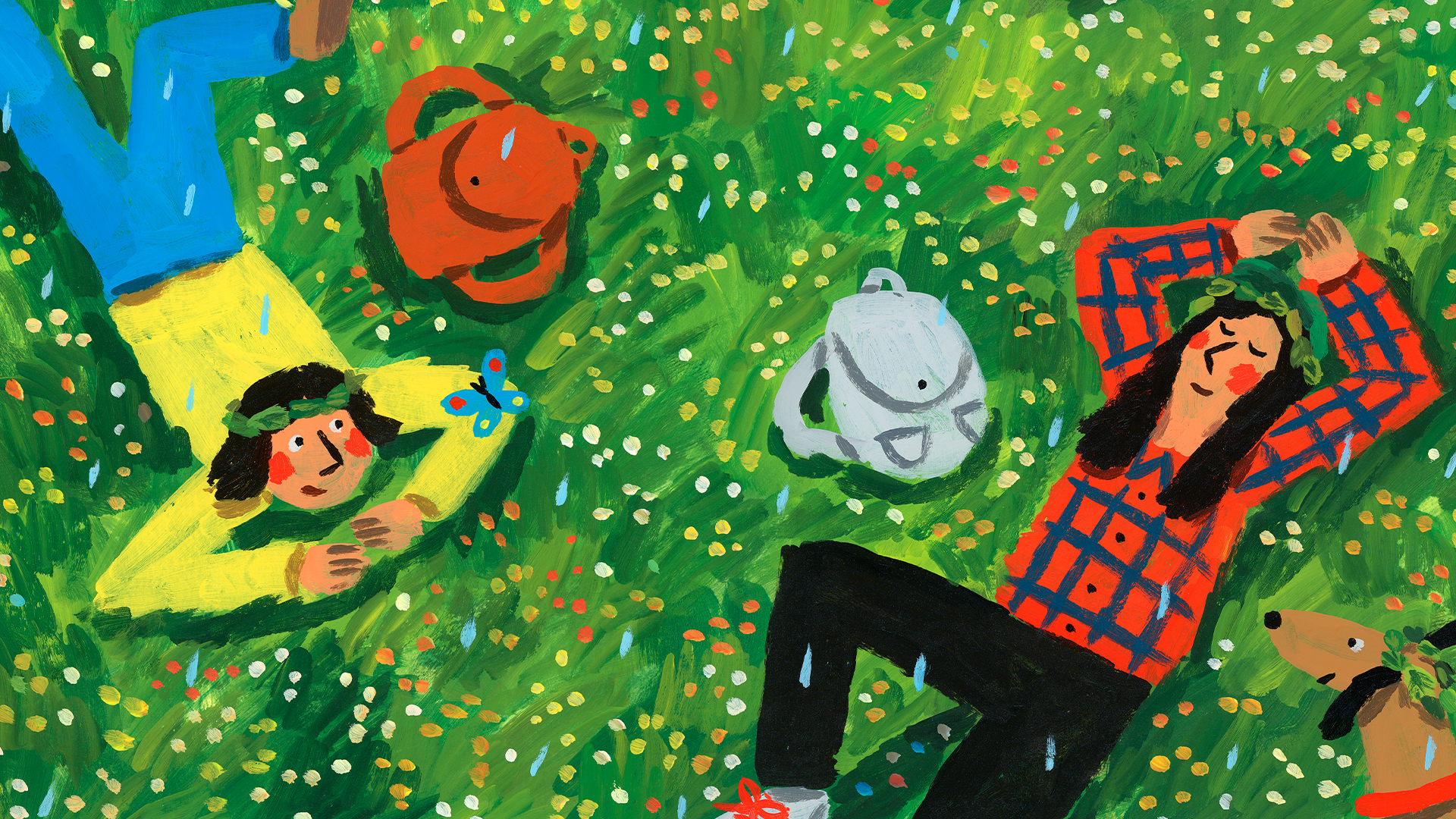
This was probably the first thing I discussed with the editor. She had in mind something inspired by pointillism and Impressionism to illustrate the idea that everything is made up of many tiny particles, and thought that my illustration style would be a good fit because of its impressionistic look.
In my first sketches, I pushed this idea further and experimented with a fully pointillist technique. But it started to feel a bit too literal, and the illustrations became harder to read. So instead, I chose to use the dots more deliberately, letting the pointillist influence come through without taking over the whole image.

The textures of the starry skies and lush fields feel beautifully raw and tactile - perfect for this topic. What physical tools did you use on your desk to achieve this depth? Can you tell us more about your illustration process from a practical perspective?
For this book, I worked with acrylic paint. I like to paint quite quickly, with expressive brush strokes and bright colours. I find acrylic paints ideal for working like this, as the paint dries fast and it’s possible to paint over and add textures easily.
When I work, I usually like to paint directly, without preliminary detailed drawings. I often make a quick sketch that works as a loose guide, and then go directly into painting. I really enjoy this approach, and the element of uncertainty that comes with it. It allows me to keep my illustrations quite spontaneous and the whole process more exciting.
There is a playful little dog companion that tags along with the children across almost every single page. Did this character come from the story via Ben, or through the illustration process? Do you think that animals help ground big topics for young readers?
The dog in the book wasn't initially part of the story – he came to my mind while I was creating the story with the mom and daughter. I thought the dog could be a link between people and the natural world. He helps us notice things, or see a different perspective. Plus, I'm always happy to see a dog in a book (or anywhere).

How did you both meet and how did your collaboration work? Did an illustration ever cause Ben to tweak a line of text, or vice versa?
Ben: I had been a fan of Marc’s outstanding work for a while. I have multiple of his books in my collection. We were introduced through our editor Friederike. When she first mentioned Marc’s name to me I was ecstatic. What an honor to have him illustrate my first picture book!
To me, the most important pivot in our collaboration was when we switched away from the idea of illustrating the text more literally to having the pictures tell a story by themselves. Marc can speak to how the text inspired his work. I can certainly say that as we started working on various early ideas, the illustrations started adding a whole new layer to the book. The vibrant colors and Marc’s unique brush strokes make you feel life in its essence; they carry the optimism I wanted the reader to feel. That life continuously moves through us.
Marc: I think the main discussion was really about how to illustrate this text. Because the text isn’t fully fiction or non-fiction, there were many different ways we could approach it. At the very beginning, I tried something a little more non-fiction, without a specific visual narration. But as I was working on it, the poetry of the text and the topic made me want to move away from something too explanatory and bring in more storytelling and characters. Because of the voice speaking in the text, I could imagine a parental figure speaking to a kid, and create a simple adventure around them. The natural world then became a way to illustrate the concepts being explained in the text.
The fun part for me was pairing each moment in the text with a natural element that could somehow illustrate it: the Big Bang became the sunrise, the atoms became the leaves, flowers, and stars, change became the wind and the storm, death became the fallen leaves, etc. That’s something I like about narrative non-fiction books: they show the beauty of the world in a way that isn’t educational, but instead tries to find the poetry in ordinary things. I wanted to apply the same idea to the visual part, and find a more poetic and artistic approach.
The spread addressing the reality that bodies die, books fall apart, and leaves turn brown can be a delicate thing to young minds. How did you approach that specific layout to ensure it felt peaceful and natural rather than frightening?
Ben: What I love about Marc’s final illustrations is that they complement the text. In many ways the pictures say the things the words can’t. And make the reader feel the emotions the text is pointing to.
Marc found a wonderful balance that doesn’t shy away from expressing the feeling but at the same time we’re not showing any of the stereotypical metaphors. I found that children are amazingly capable at holding big emotions (often much better than adults). And the illustration of this particular spread shows that: sadness and grief are real, they’re part of life. And so is renewal.
We Are All Made From Stars is available in both English and German editions.